
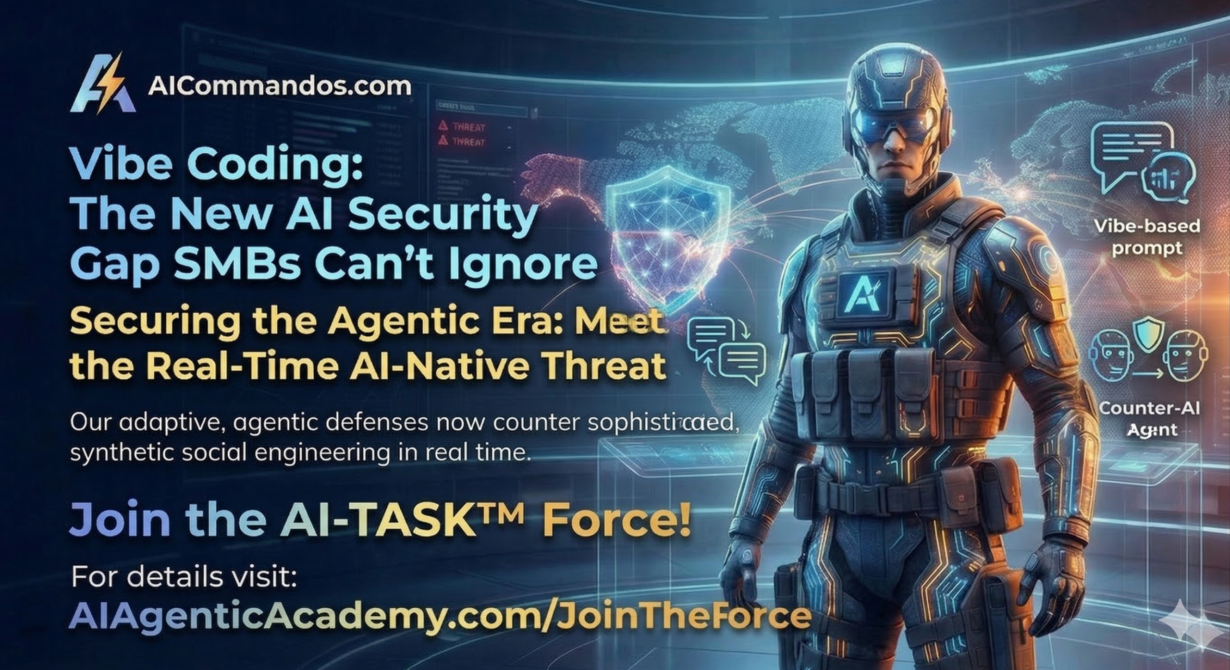
Security Alert: Vibe Coding & The New Frontier of AI-Native Social Engineering Defense

AICommandos.com & The AI-TASK™ Force – Field Intelligence Report for SMBs
While your small or medium-sized business (SMB) is racing to integrate “Vibe Coding” and AI-powered workflows for massive efficiency gains, bad actors are already optimizing the exact same tech. The next wave of cyber warfare isn’t about compromising software—it’s about compromising people.
This isn’t a future scenario. It is the emergence of AI-native social engineering in real time, and it exploits the very “feel” and rapid deployment models that give Vibe Coding its name.
The Rise of Vibe Coding (and the Accidental Vibe Gap)
First, a quick level-set: “Vibe Coding” is the practice of using high-level natural language to prompt and build complex software functions through AI, essentially coding based on the “feel” or the intended vibe of the function rather than explicit syntax. It is a powerful accelerator.
But this same capability—the ability to generate perfectly constructed, contextual output instantly—is a goldmine for social engineers. The problem is the “Vibe Gap.” Your security is rigid (code); their attack is fluid (vibe). Traditional defenses are blind to this.
The Evolution of Social Engineering: AI-Native Threats in Real Time

Historically, social engineering (phishing, vishing, business email compromise) was detectable by its synthetic feel—misspellings, awkward phrasing, or generic templates. Vibe coding eliminates these tells.
Consider these “Real-Time, AI-Native” scenarios:
-
The Contextually Perfect Phish: A generative AI agent, using Vibe Coding principles to generate a perfectly formatted, brand-aligned internal memo, targets your finance team during a known acquisition period (scraped from news). The “feel” of the memo is indistinguishable from your COO’s communication style.
-
The Deepfake Voice Compromise: An AI-powered voice bot, optimized via a Vibe-based natural language generator, calls an IT admin, matching the vocal pattern and tone of the CEO (cloned from a public keynote). It requests a rapid credential change, exploiting the perceived urgency.
-
The Weaponized Chatbot: A legitimate service chatbot is subtly manipulated by an attacker’s prompt injection, altering its internal logic (or vibe) to begin querying users for sensitive data, all while appearing perfectly functional.
The key to all of these attacks is their speed and context-awareness. They are generated in real time, at a fraction of the cost, and are contextually perfect.
Why SMBs Are Target #1
SMBs are particularly vulnerable for three critical reasons:
-
Agile Adoption: SMBs are the fastest to integrate Vibe-based workflows and Agentic AI (the use of autonomous AI agents) without a fully mature security framework.
-
The Trust Economy: Smaller companies often rely heavily on interpersonal trust and brand familiarity, making them highly susceptible to brand/identity manipulation.
-
Asset Density: SMBs hold valuable intellectual property (IP), financial data, and customer information, making them attractive targets with potentially less robust defenses than enterprise giants.
Defending the Vibe: The Rise of AI-Native Social Engineering Defense
To defend against an AI-generated attack that targets human behavior, you cannot rely on 10-year-old threat signatures. You need to deploy an AI-Native Real-Time Defense. This is a defense that understands context and “feel.”
This new paradigm of defense requires:
-
AI-Generated Detection (Agent vs. Agent): You must fight fire with fire. Implement AI security agents that can detect other AI-generated content. For example, defenses that analyze synthetic text, voice, or image markers in real time.
-
Semantic Threat Analysis: Traditional scanners look for malicious links. AI-native defenses look for malicious intent and semantic anomalies—shifts in a user’s tone, unusual workflow requests, or patterns that indicate manipulation rather than authorization.
-
Continuous Real-Time Monitoring: Security cannot be a “checkpoint.” It must be a continuous, AI-monitored state. AI-native defenses monitor interactions as they occur, flagging deviations from the established baseline “vibe” of your organization’s communications.
Actionable Intelligence for your AI-Powered SMB
-
Audit Your AI Workflows: Immediately inventory every place your team uses Vibe Coding, generative text, or Agentic AI. Identify the data these agents can access and the authority they possess.
-
Pilot AI-Native Security: Look for cybersecurity solutions that promote a dedicated AI layer. For instance, advanced email security platforms that perform intent analysis.
-
Employee ‘Vibe’ Training: Train your team to recognize that AI can mimic tone perfectly. The new instruction is to question any workflow that skips an established verification step, regardless of how perfectly “on-brand” the request feels.
-
Adopt a Zero-Trust AI Mindset: Every autonomous request from an AI agent or every piece of high-level social content must be verified, not just authorized.
The emergence of Vibe Coding is a massive productivity boon, but the security alert is clear. Your defense must evolve from a static wall into a living, AI-driven immune system that can detect and neutralize threats as they manifest in real time. The attackers have mastered the vibe. It is time for SMBs to deploy the AI-Native defense.
For a deeper dive into deploying these AI-TASK™ Force strategies, visit our AICommandos.com‘s & our AIAgenticAcademy.com AI-TASK™ Force Academy Today for details on helping to provide your own local Cyber Threat Intelligence Agency!

 0
0 0
0 20
20
 20
20