
⚠ BREAKING: Active Wartime Threat
AI Cybersecurity · National Security · Strategic Intelligence
AI-Powered Cyber Defense in Wartime: Why the US & Its Allies Cannot Afford to Wait

As U.S.–Israeli strikes reshape the Middle East and Iran’s proxies activate worldwide, the cyber battlefield is now the second front of a global conflict — and AI is the only force multiplier that can keep pace.
The geopolitical order just changed — overnight. Within hours of U.S. and Israeli forces launching coordinated strikes on Iran, killing Supreme Leader Khamenei and dozens of senior military commanders, the world’s cyber infrastructure went on full alert. The threat is not theoretical. It is active, accelerating, and targeting your business right now.
What happened in the skies over Tehran on Saturday is only the first half of this war. The second half — the invisible war — is already underway in data centers, power grids, financial networks, and the laptops of millions of Americans and allied citizens worldwide. And unlike cruise missiles, cyber weapons don’t require runways, fleets, or soldiers. They require only code, coordination, and an internet connection.
This is not a drill. This is the new normal of 21st-century warfare, and AI-powered cybersecurity is no longer optional — it is a matter of national and economic survival.
⚠ Active Threat Intelligence
Following Operation Rising Lion (June 2025), cyberattacks against Israeli and U.S. targets spiked 700% within 48 hours. Iran and its proxies — including Hezbollah, the Houthis, and state-linked APT groups — have explicitly pledged retaliation in cyberspace. The U.S. Department of Homeland Security has issued active advisories warning of escalating attacks against American critical infrastructure.
The Battlefield Has Two Fronts

Modern warfare doctrine no longer treats cyber operations as a side show. They are a primary theater — executed simultaneously with kinetic strikes to amplify chaos, degrade command and control, erode civilian morale, and extract strategic intelligence. The Iran conflict demonstrates this with chilling clarity.
Israel used cyberattacks in tandem with Operation Genesis, targeting Iranian media platforms and mobile apps to reach the Iranian population directly. Iran retaliated with DDoS campaigns, hacktivist coordination across Telegram, and targeted intrusions against financial infrastructure. Pro-Iranian group “Team 313” took down Truth Social with a DDoS attack within hours of the first missile strikes. These are not amateur operations — they are coordinated, fast-moving, and scalable.
The CSIS noted that between 2012 and 2014, Iran successfully disrupted major U.S. financial institutions in Operation Ababil. In the current conflict, with Iran suffering catastrophic leadership losses and conventional military degradation, cybersecurity analysts at Google Threat Intelligence Group warn that “targets in the United States could be reprioritized for action by Iran’s cyber threat capability” — specifically targeting privately owned critical infrastructure and civilian institutions.
-
700% Spike in cyberattacks within 48hrs of June 2025 strikes
-
74 Hacktivist groups activated in the first week of conflict
-
$10T+ Global cybercrime cost projected annually by 2025
-
<60s Speed of AI-powered threat detection vs. hours manually
Why Iran’s Proxies Make This a Global Problem
Iran’s retaliation strategy is not limited to Iranian state actors. For decades, Tehran has cultivated a sophisticated network of proxies, sleeper cells, and affiliated hacktivist collectives operating across every continent. Hezbollah maintains cells in Europe, South America, and West Africa. The Houthis have demonstrated capabilities to disrupt Red Sea shipping infrastructure. Kataib Hezbollah in Iraq has already threatened U.S. bases. Each of these groups has a cyber wing.
The Atlantic Council has warned that security services worldwide are on high alert for Iranian asymmetric retaliation via “sleeper cells” — and that Iran could activate Houthi or Hezbollah proxies, conduct assassinations, terror attacks, kidnappings, or cyberattacks against civilian or military targets in countries as diffuse as Albania, Argentina, Bahrain, Lebanon, and Sweden.
This is not a Middle Eastern problem. This is a global problem — and every business connected to the internet in the United States, Europe, Australia, Canada, or the Gulf States is a potential target.
🎯 Who Iran Targets in Cyberspace
Iranian APT groups have historically focused on U.S. government and military institutions, but current intelligence indicates a significant pivot toward privately owned critical infrastructure, businesses with Israeli ties or technology partnerships, financial institutions, healthcare systems, and energy and utilities. The DHS advisory notes Iranian actors are “exploiting poorly secured systems” — meaning most SMBs are at serious risk.
Critical Infrastructure: The Real Targets
When cybersecurity professionals talk about “critical infrastructure,” the stakes become very concrete. Iran-aligned threat groups have issued explicit warnings to Saudi Arabia and Jordan about attacks on their critical infrastructure. U.S. researchers warn the same playbook will be deployed against American targets. Here are the sectors most at risk:
⚡ Energy & Power Grid
Electrical utilities, pipelines, and oil infrastructure are primary targets for maximum civilian disruption.
🏦 Financial Systems
Banks, payment networks, and exchanges — Iran successfully disrupted major U.S. banks in 2012–2014.
🏥 Healthcare Networks
Hospital systems and health records — ransomware attacks on healthcare cause life-threatening disruption.
🌐 Telecom & Internet
Communication infrastructure, ISPs, and DNS systems underpin all other critical systems.
🚰 Water & Utilities
Water treatment and municipal infrastructure — Iranian groups have previously targeted U.S. water systems.
🏭 Manufacturing & OT
Operational technology (OT) systems in factories and industrial facilities present massive unpatched attack surfaces.
Where AI Changes Everything
Here is the fundamental problem with traditional cybersecurity in wartime: human analysts cannot move fast enough. When 74 hacktivist groups activate simultaneously, when Iran’s state APT groups pivot to new targets, when DDoS attacks scale to billions of requests per second — the response time demanded is measured in milliseconds, not hours. No human team can operate at that speed.
This is where AI-powered cybersecurity is not just an advantage — it is the only viable option. AI doesn’t sleep, doesn’t get overwhelmed by volume, doesn’t suffer alert fatigue, and improves the more it is attacked. In a wartime cyber environment, that distinction is decisive.
01 Real-Time Threat Detection
AI models analyze billions of network events simultaneously, identifying attack patterns the moment they emerge — not hours or days later when the breach has already occurred.
02 Predictive Intelligence
Machine learning models trained on geopolitical threat data can predict which infrastructure sectors are next in the attack rotation, enabling proactive defense posturing before strikes land.
03 Autonomous Response
AI-driven Security Operations Centers (SOCs) can autonomously isolate compromised systems, reroute traffic, and neutralize threats in seconds — without waiting for human authorization that takes too long.
04 Adversarial AI Detection
Iran and its proxies are now using AI to scale their attacks — launching AI-generated spearphishing at unprecedented volume. Only AI can detect AI-generated attacks at the pattern level.
05 Supply Chain Defense
State actors increasingly target third-party vendors to reach primary targets. AI continuously monitors the entire supply chain ecosystem for anomalies that human teams miss entirely.
06 Disinformation Filtering
Iran deploys massive bot-driven propaganda campaigns alongside cyberattacks. AI-powered content analysis identifies and neutralizes coordinated inauthentic behavior before it shapes public perception.
“Cyberattacks can disable warning systems ahead of kinetic strikes, disrupt an adversary’s response, and create temporary effects that physical attacks cannot. AI is the only force that can operate at the speed this threat demands.”
— Foundation for Defense of Democracies, Center on Cyber & Technology Innovation
The Adversarial AI Arms Race Is Already Underway
There is a dimension to this threat that most organizations have not yet internalized: Iran and its proxies are not using yesterday’s hacking tools. Threat intelligence firms have confirmed that Iranian-aligned groups are leveraging AI to speed up and scale cyberattacks — using large language models to craft more convincing spearphishing campaigns, machine learning to identify vulnerabilities faster, and AI-driven coordination tools across encrypted channels to orchestrate simultaneous multi-vector attacks.
This means the threat has evolved from skilled human hackers working at human speed to AI-augmented attackers operating at machine speed. The only credible defense is AI on AI. Businesses and governments that are still relying on signature-based antivirus, manual SOC review, or quarterly penetration tests are bringing a 2010 playbook to a 2026 war.
CISA, the FBI, NSA, and their counterparts in Canada and Australia have already issued joint advisories highlighting the escalating sophistication of Iranian state-sponsored hackers, specifically their use of brute-force attacks and credential theft to achieve broad system access in healthcare, energy, government, IT, and engineering sectors. The advisory came before the current escalation. The threat today is materially worse.
What Allied Governments Must Do — Now
The United States and its allies are not starting from zero. CISA, NSA, GCHQ, and their partner agencies have robust cyber defense doctrines. But wartime conditions compress timelines and expose gaps that peacetime security postures miss. Here is what coordinated national AI cyber defense looks like in practice:
First, allied governments must accelerate the deployment of AI-driven threat intelligence sharing platforms that operate in real time across classified and unclassified networks. The current Information Sharing and Analysis Centers (ISACs) are a foundation — but they need AI-powered ingestion, analysis, and alerting to match adversary tempo. Second, critical infrastructure operators — particularly in energy, finance, and water — must be mandated to meet AI-enhanced minimum security baselines, not the legacy compliance frameworks written before the modern threat landscape existed. Third, offensive cyber doctrine must be incorporated as a strategic deterrent, as the U.S. demonstrated when it chose a cyberattack over a kinetic strike against Iranian SAM systems — a decision that demonstrably de-escalated the conflict while preserving deterrence.
What Your Business Must Do — Today
If you operate a business in the United States or any allied nation, you are not a bystander in this conflict. Iranian threat groups specifically target businesses that work with Israeli vendors, use Israeli technology, or are simply opportunistic targets of automated exploit campaigns. Here is your immediate action checklist:
Threat Assessment First. Conduct an emergency review of your exposure — are any of your technology vendors, suppliers, or SaaS platforms Israeli-based or known targets? Do you use Siemens PLCs or other operational technology that has been previously targeted? Your supply chain is your attack surface.
Patch Everything, Immediately. Iranian APT groups are exploiting known vulnerabilities in firewalls, VPNs, and routers. Every unpatched system is an open door. Run an emergency patch cycle today, not next sprint.
Enable AI-Powered Monitoring. If you are still running a reactive security model, you are already behind. Deploy AI-driven endpoint detection and response (EDR), network detection and response (NDR), and cloud security posture management (CSPM) tools. The cost of these tools is a fraction of the cost of a breach — and in wartime conditions, breaches happen fast.
Train Your Team on Wartime Phishing. Expect a surge in AI-generated, highly targeted spearphishing campaigns. Your employees are the most exploited entry point. Run an emergency phishing simulation and briefing within the next 72 hours.
Segment Your Networks. Ensure that operational technology (OT) and information technology (IT) networks are segmented. If attackers breach your business network, they should not be able to pivot to industrial control systems, HVAC, or physical access controls.
🔑 The AI Commandos Perspective
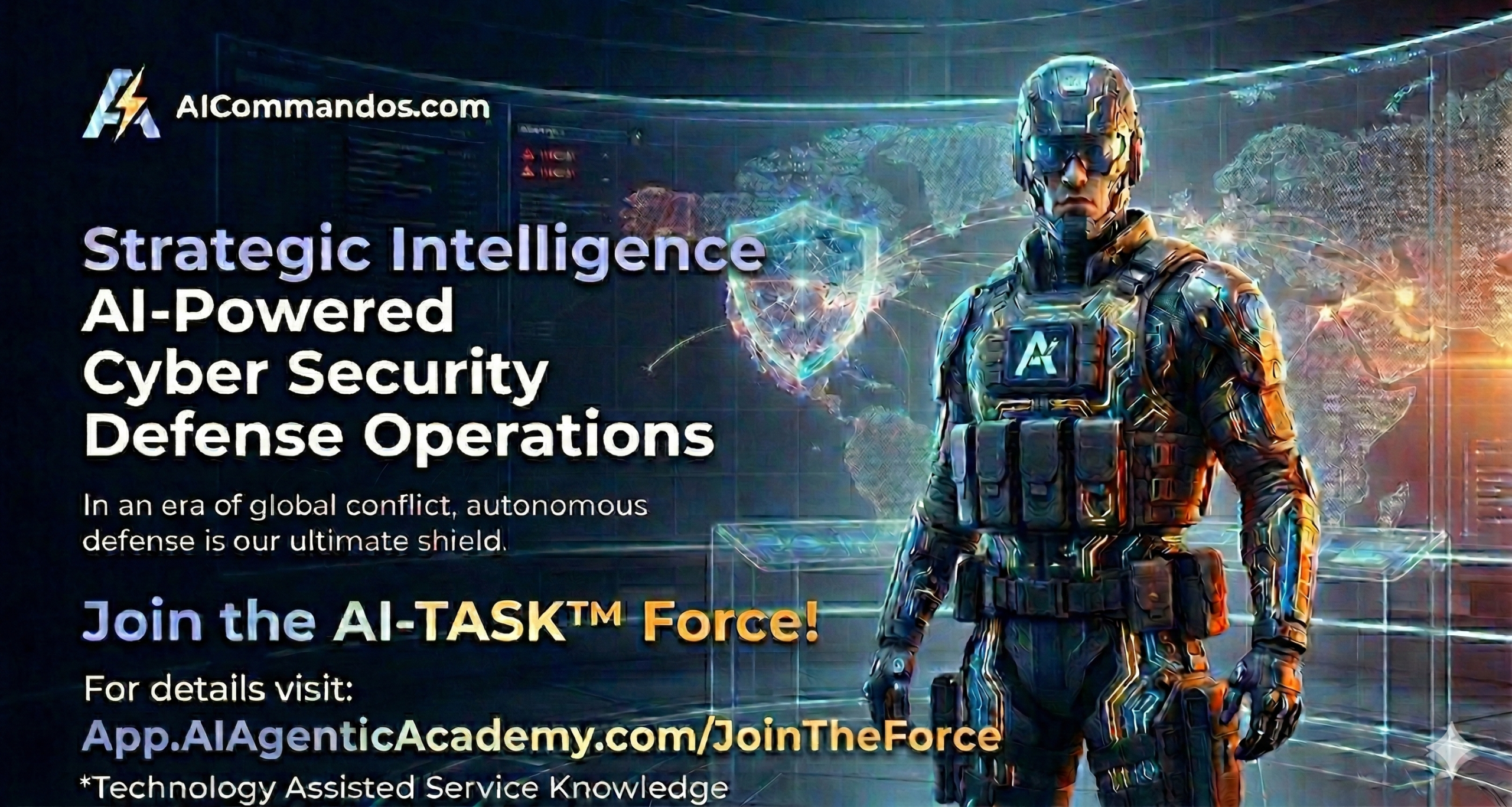
At AICommandos.com, we train businesses to deploy AI as a strategic operating system — not just a productivity tool. Cyber defense is the highest-stakes use case in that doctrine. The organizations that will emerge intact from this era are the ones that treat AI-powered security as a core business function — not an IT afterthought. The battlefield is digital. The time to deploy your AI forces is now.
The Larger Strategic Reality
Zoom out for a moment and consider what this conflict represents strategically. The U.S.–Israel operation against Iran is not an isolated event — it is the most significant reshaping of Middle Eastern geopolitics since the 2003 Iraq invasion, and its reverberations will extend for years. Iran’s proxy network spans Lebanon, Yemen, Iraq, Syria, and cells across Europe, the Americas, and Southeast Asia. Even a significantly weakened Iran — one with its top leadership decapitated and its missile infrastructure degraded — retains substantial cyber capability. And its allies Russia and China will be watching, learning, and potentially assisting with counter-intelligence and cyber tools.
Meanwhile, this conflict is happening against a backdrop of ongoing Russian cyber operations targeting NATO infrastructure, Chinese advanced persistent threat groups embedded in U.S. critical infrastructure “for future use,” and North Korean state hackers funding their ballistic missile program through crypto theft and ransomware. The United States and its allies are fighting a multi-front cyber war — with most businesses and many government agencies still operating peacetime security budgets and postures.
AI-powered cybersecurity is the force equalizer that makes it possible to defend against all of these threats simultaneously. No other technology offers the scale, speed, and intelligence required.
Conclusion: This Is the Defining Security Moment of Our Generation
The events of the last 72 hours represent a before-and-after moment in global security. The kinetic war in the Middle East will eventually reach some form of resolution — diplomatic, military, or otherwise. But the cyber war that has been activated by this conflict will not end. It will intensify, evolve, and expand as adversaries use AI to find new vectors, new targets, and new attack methods at a pace that no human-only security team can match.
The United States has demonstrated, in this very conflict, that cyber operations are not just a complement to kinetic warfare — they are a primary strategic tool that can substitute for physical strikes and control escalation dynamics. That same understanding must now cascade down from the Pentagon to every organization in America and across our allied nations.
AI-powered cybersecurity is not a vendor pitch. It is a wartime necessity. The question for every leader — in government, enterprise, and SMB alike — is no longer “should we invest in AI cyber defense?” The question is: “How quickly can we deploy it, and what is it costing us every hour that we haven’t?”
Deploy Your AI Defense — Now
AICommandos.com helps businesses build AI Operating Systems that include AI-powered security frameworks, threat intelligence integration, and automated defense postures. Don’t wait for the breach. Mobilize now.
Join AICommandos & AI Agentic Academy’s AI-TASK Force →

 0
0 0
0 20
20
 20
20